Crypto exchanges
Why no connection is needed
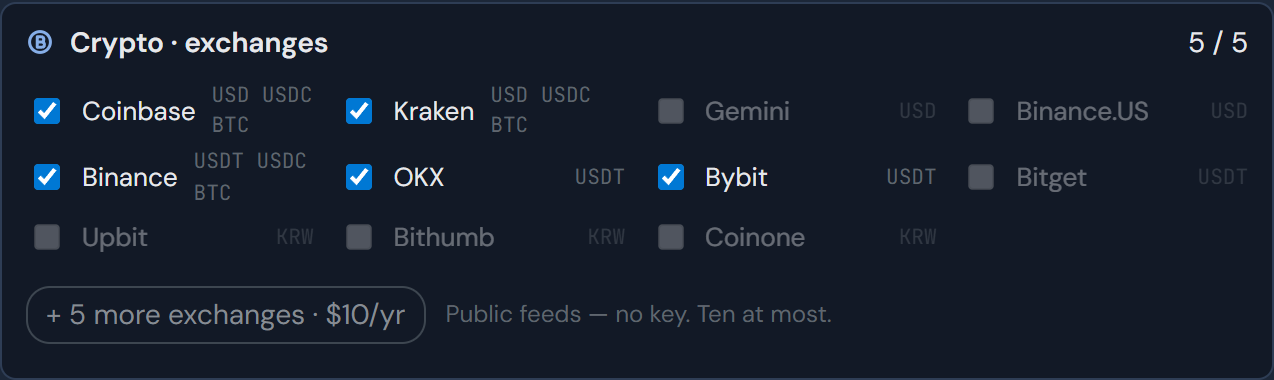
Crypto exchanges publish their prices openly. Deck includes five exchanges, and you pick them. There is no account to create and nothing to paste.
What “connecting more” means
Connecting more exchanges doesn’t involve a key either. It means ticking more exchanges in your connections:
- Open Settings → Connections → Crypto · exchanges.
- Five places are included. Tick the exchanges you want in them.
- For more than five, add five more exchanges ($10 a year), up to ten in all.
- Crypto components in your decks can then use those exchanges. The ticker shows them once the deck is on a line.
In a component, the exchange list follows the settlement currency you choose, so a pair that doesn’t exist can’t be picked.
Connecting your broker
Stocks, and the indexes that come with your account, reach the ticker through a key that your broker issues to you. You do this once per computer.
1. Apply for API access at your broker
Most investors already use their broker’s trading program or app (HTS or MTS). The API key is usually not issued inside that program. It is applied for separately, on the broker’s website or its developer site. Where and how is listed under By country. You need an account at that broker first; some brokers also issue keys for a mock-trading account.
2. Get what your broker issues
Most brokers give you two values: a key (often called App Key or API Key) and a secret (App Secret or Secret Key). Some show the secret only once, so copy it before you close the page. A few brokers, such as Interactive Brokers and Futu/moomoo, issue no key: you sign in to their own program on your computer, and ScoutDex connects to that program.
Treat a key like a password. ScoutDex only reads prices and never sends an order.
3. Open the connection window in the app
In the ScoutDex app, open Settings → Connections, choose Add a broker, and pick your broker. If you are in the studio in your browser, Open in the ScoutDex app takes you there.
The app then asks for what that broker uses: a key and a secret, or a sign-in to the broker’s own program.
4. Connect and check what opened
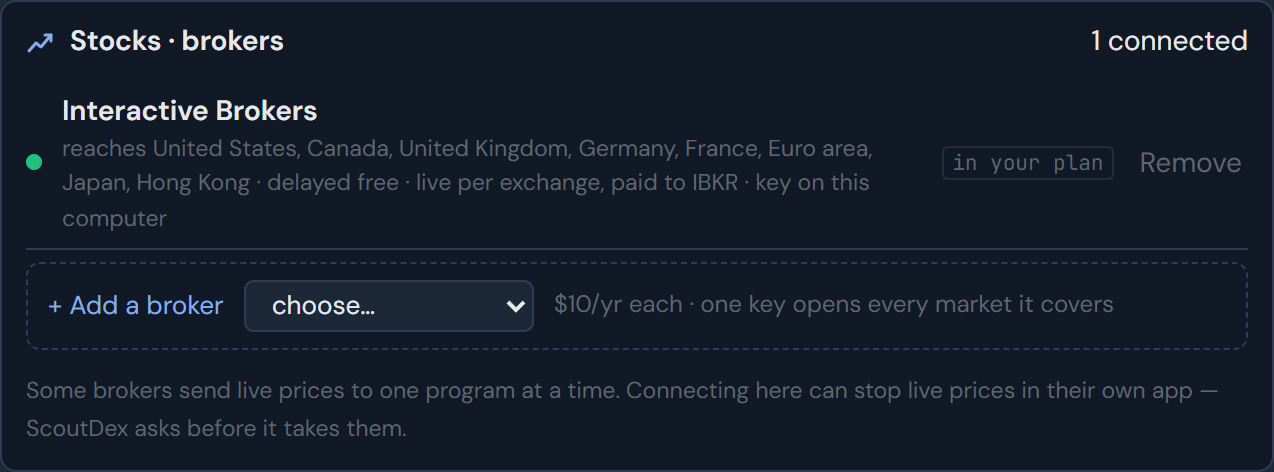
Once your broker accepts it, the broker appears under Stocks · brokers with the countries it reaches and what live prices cost there. The key is then kept in Windows Credential Manager. It is never in a backup, a log or a deck you share, and we can’t see or recover it.
Some brokers send live prices to one program at a time. Connecting ScoutDex can stop live prices in the broker’s own app, so ScoutDex asks before it takes them.
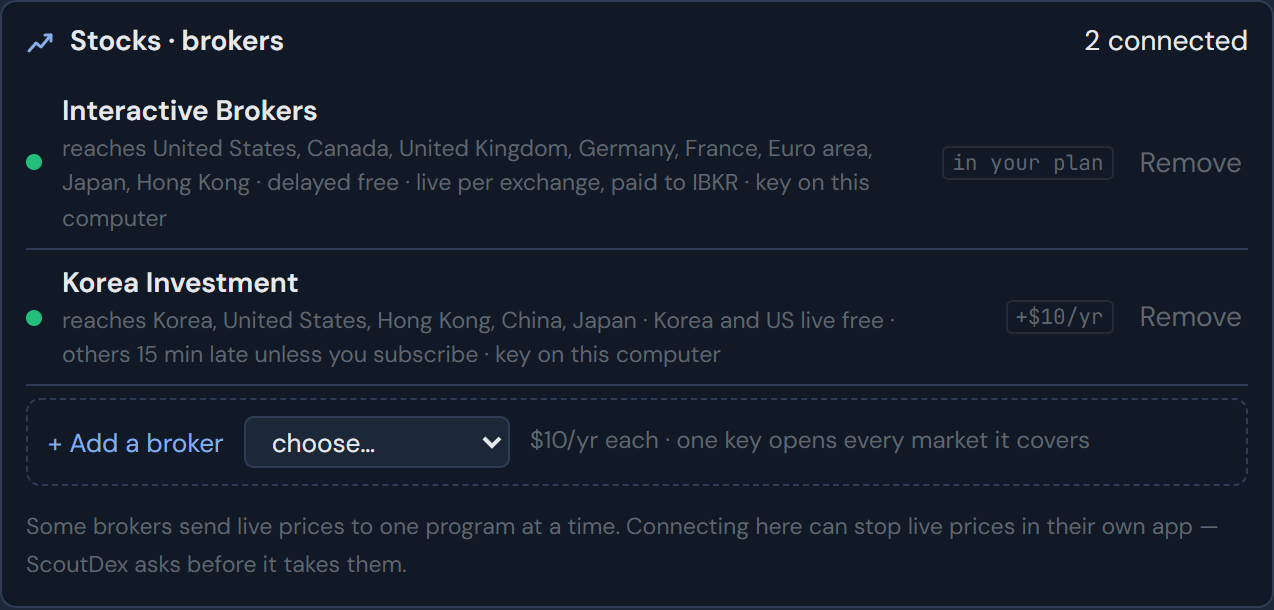
One broker is included with Deck. Each further broker is $10 a year.
5. Back in the studio
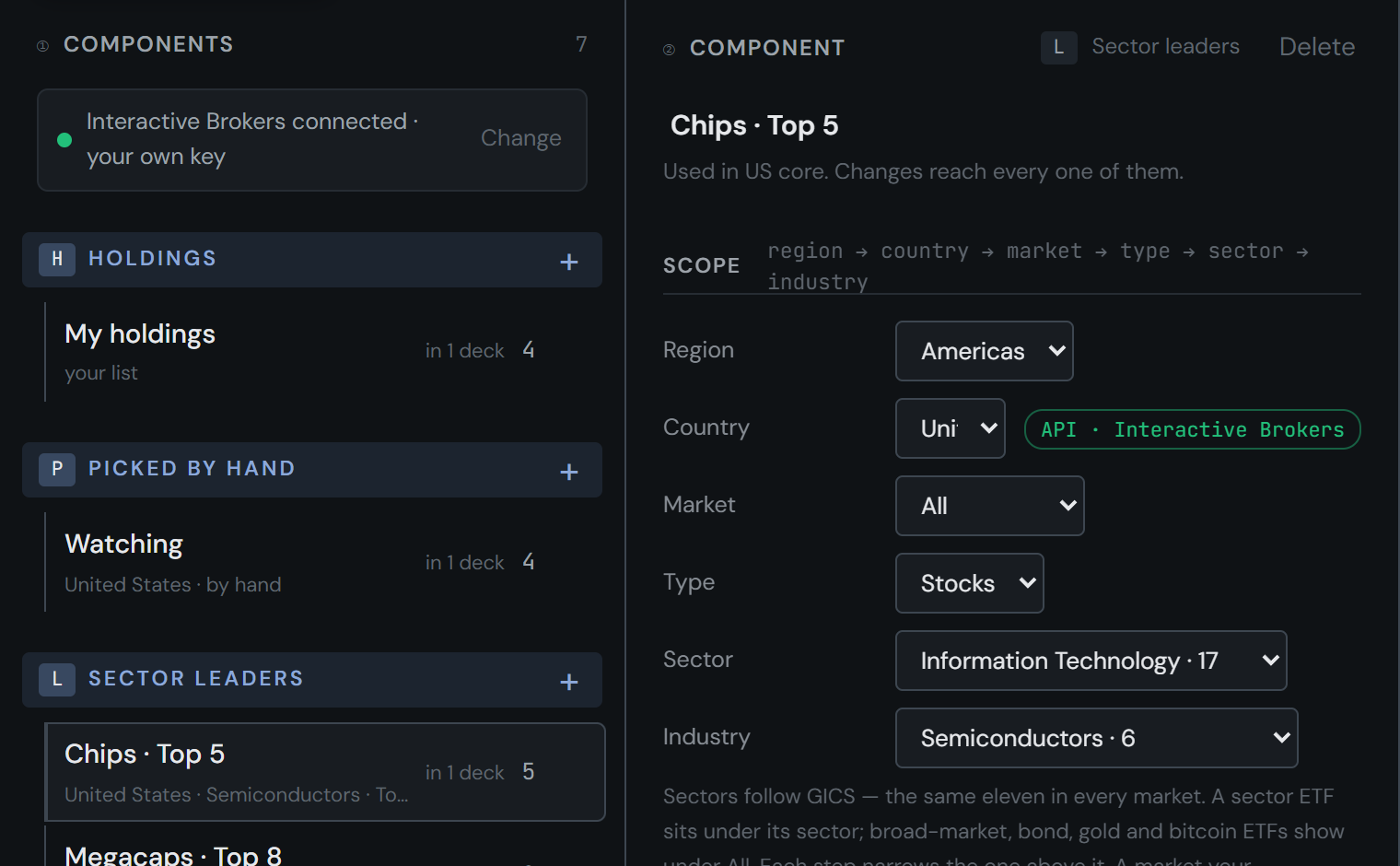
Return to the studio. The top of the components column shows the broker as connected, and in a stock component each country it reaches carries an API tag naming that broker.
On a second computer, paste the key again. It is never copied between devices.
Connecting news
No key
News sources publish public feeds. Your computer reads them directly, so there is nothing to sign up for.
Why it’s done in the app
Browsers are blocked from reading most RSS feeds directly. The studio in the app reads them without that limit, so steps that read feeds run there. The studio in your browser hands over with Open in the ScoutDex app.
Choosing sources
- In the app, open the studio and start a news component.
- Pick a language and a country, then a topic. Markets & economy is the default; other topics come from feeds you add yourself.
- Tick the sources you want. Only those appear on the line.
News from public sources comes with Deck. A news service you already pay for counts as one more connection, at $10 a year.